October is National Safe Work Month. Each week, Cooper Grace Ward’s workplace relations and safety team will ask you to think about the safety systems and practices in your business.
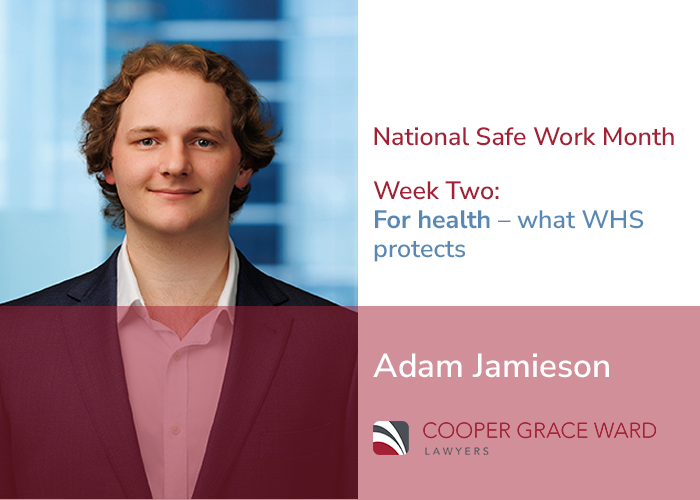
In this second instalment, lawyer Adam Jamieson looks at week two’s theme, ‘For health – what WHS protects’. Work health and safety protects against more than physical injuries. Psychosocial hazards, such as high work demands and isolated work, can cause mental health injuries, and the most serious harms are not always visible straight away. It is important to identify the hazards in your workplace and consider the hierarchy of controls, which places elimination first and administrative measures and personal protective equipment last.
Video transcript
Welcome back to National Safe Work Month, where we’re looking at a key focus area for work health and safety for each week of October. Last week we looked at why work health and safety matters. This week we’re broadening that conversation to what work health and safety actually protects.
This invites us to think about injuries that are beyond the obvious. Work health and safety protects against more than just physical injuries like falls and broken bones. Think also about the risks of psychological injuries that are caused by psychosocial hazards that may be present in the workplace. So think high work demands, low job control, isolated work, vicarious trauma. All of these can lead to mental health injuries to workers.
Another key point is that the most serious harms aren’t always the ones that you can see straight away. A single loud noise might not be too bad, but years of exposure can lead to permanent hearing loss. One stressful work week might be manageable, but chronic high work demands can lead to a long-term psychological injury.
This week, we encourage you to think about identifying physical and psychosocial hazards that are present within your workplace. Think about what risks they pose to workers, not just today, but over time, and consider what protections are in place and whether they’re sufficient.
To help with that, think about the hierarchy of controls. The most effective controls eliminate the hazard altogether. Next, you can substitute the hazard, or isolate it, or engineer it away. Administrative controls and personal protective equipment come last because they rely on staff following procedures, which isn’t always guaranteed. So if you’re relying only on administrative measures or PPE, you may wish to consider whether there are other more efficient controls that are available.
By looking at identifying hazards in your workplace and the corresponding risks, you get a clearer picture of what your work health and safety measures are actually protecting, and that’s the purpose of this week’s topic. Please join us next week for the next instalment in our National Safe Work series.